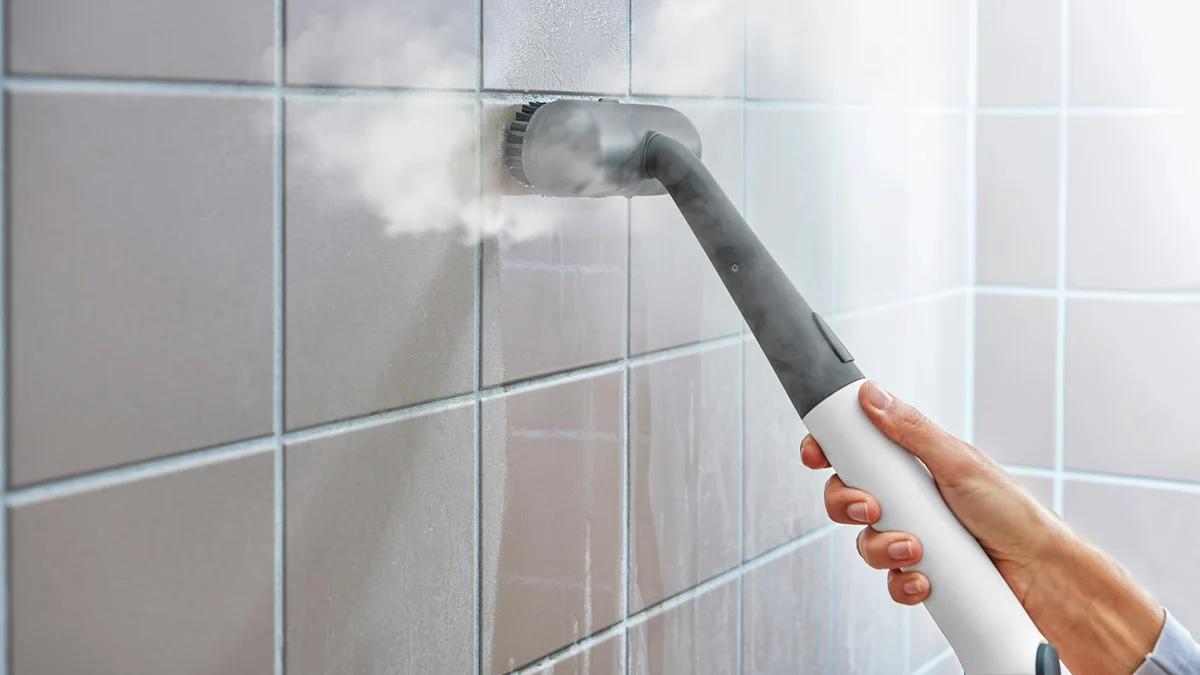
What steam actually does to dirt
Steam does not scrub dirt away; it softens the bond with heat and pushes soil out of the pore. The pressurised steam leaves the nozzle very hot, but the temperature drops sharply within a few centimetres of the surface. That is why distance decides everything — hold the tool too far back and you simply will not get the effect you paid for. Grease, soap scum and limescale loosen at that heat, and the microfibre cloth that follows does the rest of the work.
What is sold as dry steam is steam with most of its water content removed: it dampens a surface rather than wetting it, and dries within minutes. Domestic steam mops usually run wetter, which means a real risk of leaving water on the floor. There are also whole categories of dirt that heat will never touch. Rust, ink, paint and dye that has soaked into a pore do not respond to steam, and insisting on them only tires the surface, not the stain.
Surfaces where steam earns its keep
Glazed tile, ceramic, porcelain and the grout between them are where steam performs best. The mix of soap scum and limescale in a shower enclosure softens with heat, which cuts the scrubbing down dramatically and spares you the wire brush — and abraded grout only gets dirty faster next time. A fine nozzle reaches the ring at the base of a tap and the joint line between basin and worktop, places a cloth never truly enters. In a coastal town like Çanakkale, where humidity stays high most of the year, bathroom grout rarely dries out completely, so it needs attention on a schedule.
In the kitchen, the three parts that benefit most are the oven cavity, the hob grates and the aluminium extractor filter. Burnt-on grease hardens a little with every roast; a spray eventually just slides over it, while heat loosens the layer. The folds in the rubber gasket of an oven or fridge door open up easily with a brush tip, and that is precisely where a cloth cannot go. On mattresses, divan bases and carpet, steam refreshes the fibre and leaves conditions dust mites do not like — but dead mites and their residue remain on the surface as allergens, so a vacuum with real suction afterwards is not optional.
Surfaces to keep the steam away from
Top of the list is untreated or oil-finished wood. Steam strips the protective finish and raises the grain, and once the timber dries that raised grain does not settle back down. Laminate flooring comes next: the top layer may look waterproof, but the HDF core underneath swells when it takes on moisture, the joints lift, and the damage cannot be repaired. Even on boards marketed as steam-ready, never let the mop pause in one spot. Solid wood follows the same logic — the lacquer dulls over time and starts holding marks.
The second risky group is anything held together with adhesive. The PVC edge banding on worktops and cabinet doors, LVT and PVC tiles, glued-down carpet and vinyl sheet are all fixed with glue that softens under heat, and the edge you steamed can start lifting within hours. The tool decorators use to strip wallpaper is, after all, a steamer — so never point one at a papered wall. Painted walls, plaster cornices, antique furniture, leather upholstery and anything electrical, from sockets and switches to built-in control panels, belong on the same list. Polished natural stone shows no instant damage, but heat shortens the life of the sealer, and porous travertine simply takes the moisture in.
Steam on fabric: what it refreshes, what it won't wash
Most upholstery carries a single-letter cleaning code, usually on a label under the seat: W for water-based, S for solvent, WS for either, and X for vacuum only. On S and X coded fabrics, steam or water can leave a permanent watermark or make the dye travel. Viscose, rayon and silk blends are the most delicate members of that group — wherever they get wet they mark, and the mark stays once it dries. If you cannot find the label, test on a hidden area such as the lower rear edge of the sofa and wait for it to dry fully before deciding.
On fabric, steam refreshes and loosens surface soil; it does not take the dirt out of the room. All you actually remove is what transfers onto the cloth — the rest stays between the fibres and inside the foam. That is why steam alone achieves little on a sofa that has never been washed, and the loosened soil can even settle into a visible ring as it dries. To genuinely extract dirt you need an injection-extraction machine that pulls the water back out along with it. Steam helps before or after that process; it is not a substitute for it.
Six mistakes people make with a steam cleaner
The most common one is holding the steam in a single spot for too long. As heat builds up, lacquer, polish and adhesive suffer; moving slowly and, where needed, making several short passes over the same area is far safer. The second is not wiping after steaming — loosened dirt just sits there and resettles more stubbornly once it dries. The third is aiming steam straight at cold glass in winter; the sudden temperature difference carries a real risk of cracking single-glazed panes, so keep your distance and warm the glass gradually from the edges.
Mistake four is filling the tank with tap water. Water is hard in Çanakkale centre and across most of the districts; scale builds up in the boiler, strains the heating element and blocks the jets, while filtered or distilled water noticeably extends the machine's life. Fifth is using the same attachment for everything — the fine grout nozzle and the triangular fabric head do entirely different jobs, and the wrong one either does nothing or leaves marks. Sixth, and by far the most dangerous, is combining steam with bleach: heated bleach releases chlorine vapour, and in a closed bathroom that is a serious respiratory hazard. The whole advantage of steam is that it does not need a chemical alongside it.
Where to stop, and where a professional starts
With a domestic steam cleaner you can comfortably handle bathroom grout, the shower enclosure, hob grates, tile joints and kitchen cabinet fronts yourself. Get into the habit of switching attachments to suit the job, controlling your distance and wiping immediately behind the steam, and the results will surprise you. Professional work usually begins at three points: when the soil has built up in layers (a neglected oven, a saturated extractor filter), when the surface itself is risky (natural stone, delicate fabric, glued finishes), and when the dirt has to be extracted rather than loosened (sofas, carpets, mattresses). Those three need more than a stronger machine — they need judgement about how much a given surface can take.
At Derin Temizlik we have been working since 2021 across Çanakkale centre and Kepez through to Biga, Gelibolu, Ezine and Ayvacık, and every job starts in the same place: identifying the surface. During the survey we check whether the floor is laminate or solid, what the upholstery code actually says and how worn the grout is, and where steam is the wrong tool we move to machine washing or a product suited to that surface. If you are unsure about something in your own home, get in touch before you test it — more often than not the answer is simply not to point steam at it.
Frequently asked questions
Does steam cleaning replace disinfection?
Not entirely. The heat of steam reduces soil and microbial load on a surface, but that only happens if the surface stays at temperature long enough — on a worktop you pass over quickly, the contact time is very short. For nurseries, offices and high-touch points, ULV fogging and dedicated surface treatment are a separate job. The two complement each other: steam removes the dirt, disinfection goes on top of a clean surface.
Can I use a steam mop on laminate flooring?
We would advise against it. The wear layer may resist water, but the HDF core beneath it swells once moisture gets in and the joints lift — damage that cannot be fixed without replacing the boards. Even on products sold as steam-ready, pausing the mop in one place can produce the same result. A well-wrung damp mop followed by a dry cloth is a much safer routine on laminate.
Will steam remove every stain?
No. Steam excels on soil that softens with heat: grease, soap scum, limescale and sticky residue. It has almost no effect on rust, ink, paint, pen marks or dye that has soaked into a pore — those need the right chemical or mechanical treatment. Holding steam on that kind of stain usually damages the surface finish rather than shifting the mark.
Is steaming a sofa the same as washing it?
It is not. Steam loosens surface soil and freshens the weave, but it does not take the dirt out of the room; most of what it loosens stays between the fibres and inside the foam. Real washing is done with an injection-extraction machine that draws the water back out along with the soil. And if the fabric code reads S or X, neither water nor steam should be used on it at all.
Can steam be used on marble, granite and travertine?
Only with care. Polished granite and marble show no immediate damage, but repeated heat shortens the life of the sealer, and the stone starts picking up stains more easily over time. Porous stones such as travertine let the moisture in, which is not something you want in the long run. On natural stone use low pressure, keep your distance and dry immediately afterwards — and if you are unsure, test on a hidden area first.